

Download helpful resources and hear from a real person living with polycythemia vera
Download resources to support you in your treatment journey
Doctor Discussion Guide
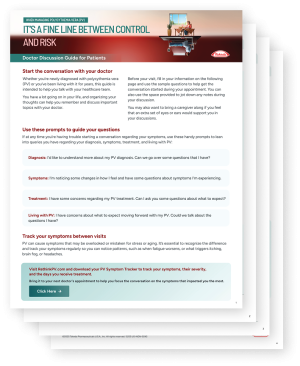
Use this guide to help start the conversation with your doctor about PV—including your diagnosis, symptoms, treatment, and day-to-day life. Bring it to your appointment so you don’t forget what you want to discuss.
Symptom Tracker
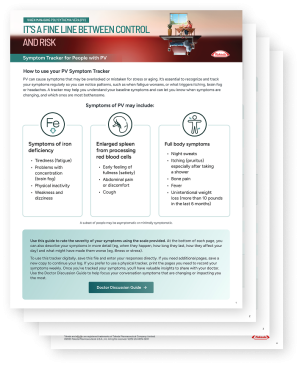
Use this tracker to record your day-to-day symptoms between appointments. Bring it to your next visit to help you and your doctor talk through how you’ve been feeling over time.
PV Information Brochure
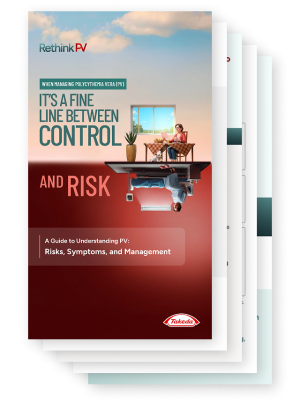
Download a guide explaining treatment goals, common symptoms, the role of iron, and tips for talking with your doctor about how you’re feeling.
Hear a real person’s experience with PV
Watch as a real person with PV shares what their diagnosis meant for them, how life has changed since, and how they’re navigating what comes next.
Real patient story
Hear a patient discuss their disease journey—from diagnosis and the real-life impact of symptom burden, to navigating the uncertainty that can come with PV.
ViewHide Transcript
0:06: Music has been a part of my life since I was about 4 years old, and the piano is where I pour my soul.
0:12: It's the one thing that I feel like is constant for me.
0:17: I found out that I had PV in March of 2024.
0:24: I didn't know what polycythemia vera was.
0:27: I didn't know what therapeutic phlebotomy was.
0:32: I had started the treatments with one doctor, and then when I went to my new doctor, she didn't see any evidence of PV.
0:42: She also was one of those people who didn't really think that it was anything to worry about.
0:48: So I stopped doing the phlebotomy for several months.
0:51: And I remember calling my doctor and saying, you know, can we just do another blood test?
0:57: When the test came back, it was very evident that I had PV.
1:04: I tend to lose focus kind of easy these days, and I don't really like that.
1:12: I don't like that I feel dizzy a lot.
1:15: I don't like that I have headaches.
1:17: I don't like that I'm tired.
1:19: I lost the ability to do things that had been like breathing for me.
1:25: I have a song that I played on the piano.
1:26: It's my very, very favorite thing to play.
1:29: And it was like I couldn't make the connection between my brain and my fingers.
1:36: I couldn't play it, and it really scared me, and I don't like that I worry about what if it doesn't get better.
1:45: And it's been a long road.
1:48: I've seen situations where people have this and they've gone untreated for way too long. But positively,
1:55: it's given me a freedom to speak out about my health, to make sure that other people understand what PV is.
2:09: I really want anyone who has this to know that it is serious and that there is good information out there about it.
2:18: If someone's doctor is not giving them the information.
2:23: I really want to encourage any patients, and I guess this would go for anybody,
2:29: ask questions,
2:30: find out everything you can
2:33: about whatever it is that your doctor is telling you that you have.